

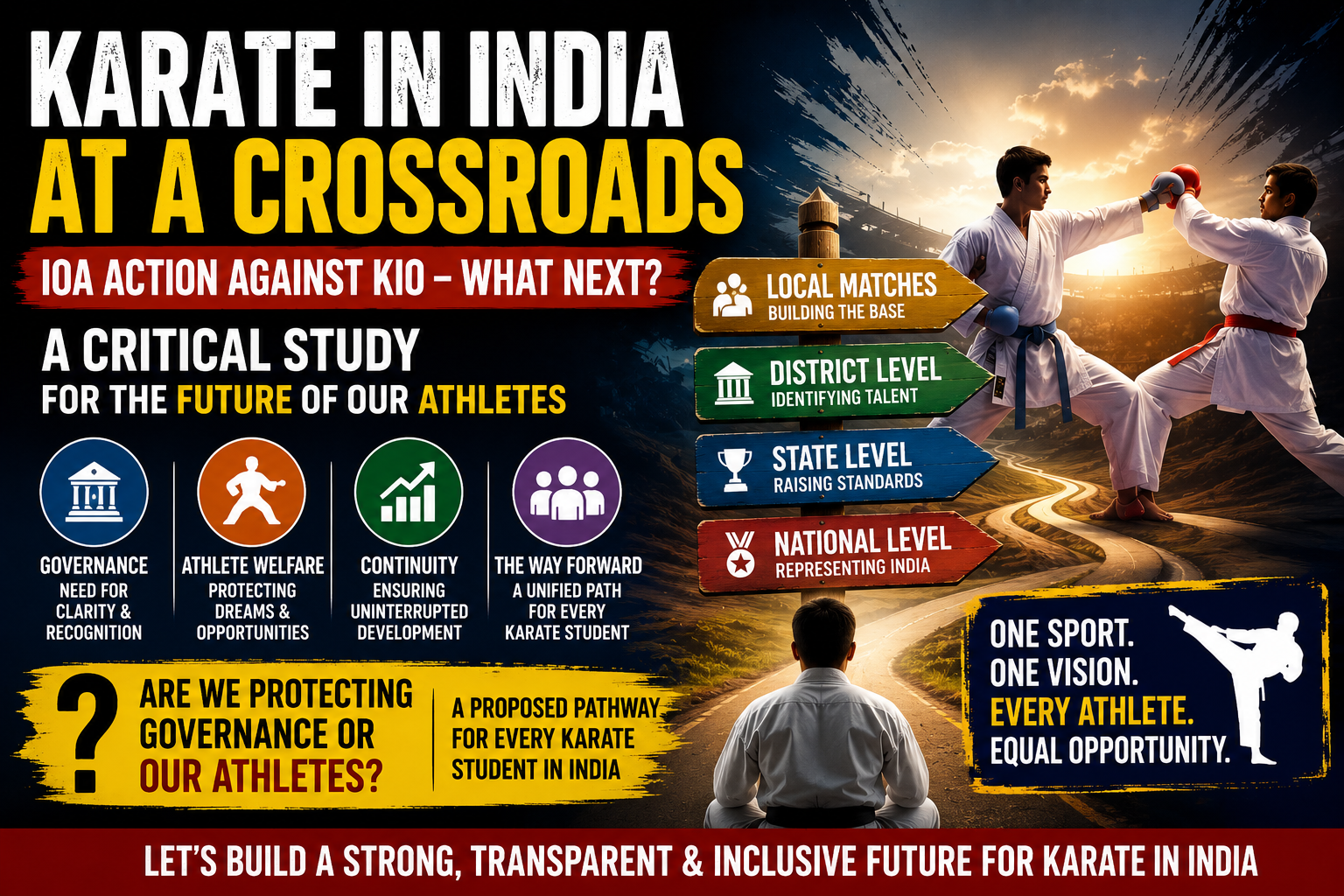
The recent notice issued by the Indian Olympic Association (IOA) against the Karate India Organisation (KIO) has once again brought Indian karate into the spotlight. While the debate has largely focused on recognition, authority, and governance, a more important question remains unanswered:
What happens to the athletes?
For thousands of karate practitioners across India, the issue is not merely administrative. It directly affects their opportunities to compete, progress, earn recognition, and pursue excellence in the sport they love.
This article presents a detailed critical study of the recent developments, examines the implications for athletes, and proposes an alternative framework that could protect karate students regardless of organizational disputes.
Understanding the Recent Development
The recent action by the Indian Olympic Association (IOA) against the Karate India Organisation (KIO) may be justified from a governance and recognition perspective. Every sport requires a legally recognized structure to ensure transparency, accountability, and proper representation. However, the real concern extends beyond organizational authority and directly impacts thousands of karate athletes who have been competing through KIO-affiliated events for many years.
While the focus has been on who has the authority to govern karate, a more important question remains unanswered: What is the alternative pathway for athletes? If one competitive structure is restricted, athletes deserve a clear and immediate replacement system through which they can continue competing, progressing, and pursuing national and international opportunities.
The core issue is not whether administrative reforms are necessary, but whether athlete interests are being adequately protected during the process. Governance should strengthen opportunities for athletes, not reduce them. If the objective is to develop karate in India, then the discussion must move beyond organizational disputes and focus on creating sustainable competition pathways at the local, district, state, and national levels.
The critical question therefore remains: Should athletes be made to wait for administrative disputes to be resolved, or should a parallel system be established to ensure their sporting journey continues uninterrupted?
The Core Issue: Governance vs Athlete Welfare
Sports administration exists to serve athletes, not the other way around. While governing bodies have an important responsibility to maintain standards, transparency, accountability, and legal compliance within a sport, these objectives should never come at the expense of athlete development and participation. Whenever a governing authority takes action against an organization, the discussion should not be limited to whether the decision is legally justified. Equally important is the question of how athletes will continue to access competitive opportunities, progress in their sporting careers, and pursue their aspirations. The first issue concerns governance and administration, but the second concerns the future of the sport itself. A successful sports governance system is one that not only enforces rules and regulations but also ensures that athletes remain protected, supported, and provided with clear pathways for growth regardless of administrative disputes occurring above them.
If an existing competitive pathway is being restricted or discontinued, what immediate alternative mechanism has been established to ensure that athletes continue to receive opportunities at the district, state, national, and international levels without interruption?
Arguments Supporting the IOA Position
A sport cannot function effectively when multiple organizations simultaneously claim authority over its governance and administration. In such situations, confusion often arises regarding championships, athlete selection, official representation, and recognition of achievements. The existence of competing governing structures can result in multiple national champions, inconsistent selection procedures, uncertainty in government recognition, and difficulties in securing funding and institutional support. From this perspective, efforts by the authorities to establish a clear and legally recognized governance framework have merit, as uniformity and accountability are essential for the long-term development of any sport.
While efforts are being made to establish a single recognized structure for karate in India, what concrete steps are being taken to ensure that athletes do not lose competition opportunities, ranking pathways, and developmental support during this transition period?
2. Protection Against Misrepresentation
Many athletes and parents naturally assume that participation in a national championship automatically carries official recognition and legitimacy. Therefore, sports authorities may argue that restricting activities conducted by organizations lacking recognized status is necessary to prevent confusion and protect athletes from investing their time, effort, and resources in competitions whose achievements may not be formally acknowledged. This concern is understandable and highlights the importance of transparency within the sporting ecosystem. Athletes deserve clarity regarding the status of championships, selection processes, and the recognition of their accomplishments.
However, this also raises an important question for the authorities: How will athletes and parents be clearly informed about which competitions, championships, and pathways are officially recognized, and what alternative opportunities are available to those who may be affected by such restrictions?
3. Alignment with National Sports Policy
The Government of India has traditionally followed the principle of recognizing a single governing body for each sport in order to maintain uniformity, accountability, and administrative efficiency. A centralized governance structure helps streamline policy implementation, athlete selection procedures, funding distribution, international representation, and coordination with national and international sporting institutions. In theory, a single recognized body reduces confusion among athletes, coaches, educational institutions, and government agencies while ensuring that decisions are made through a clear chain of authority. From this perspective, the IOA’s action appears to be consistent with the broader objective of establishing an organized and legally compliant framework for the governance of karate in India.
However, while administrative uniformity may simplify governance, the ultimate purpose of any sports system should be the development of athletes and the growth of the sport itself. Recognition alone does not guarantee participation opportunities, talent identification, or grassroots development. If a recognized structure is to replace an existing one, athletes, coaches, and clubs deserve a clear roadmap explaining how competitions will be conducted, how teams will be selected, and how opportunities will be preserved during the transition. A governance model should not only establish authority but also ensure continuity and confidence within the sporting community.
This therefore raises an important question for the Government and sports authorities: Beyond establishing a single recognized governing body, what specific measures are being implemented to ensure uninterrupted competition opportunities and a transparent development pathway for the thousands of karate athletes currently active across India?
Critical Concerns About the Decision
While governance concerns are valid, several important criticisms must also be examined.
1. No Immediate Alternative for Athletes
This is the most significant concern.
If athletes are prevented from competing through one structure, another structure should be ready to replace it.
Questions athletes are asking include:
- Where can we compete now?
- Who will organize championships?
- How will rankings be maintained?
- How will selections occur?
- What is the pathway to international participation?
Without clear answers, uncertainty grows.
2. Athletes Are Paying the Price
The dispute is administrative.
The consequences are athletic.
Athletes have invested:
- Years of training
- Financial resources
- Travel expenses
- Competitive preparation
Many now find themselves caught between organizations.
A young karateka should never have to become an expert in sports politics merely to participate in a competition.
3. Loss of Competitive Opportunities
Karate athletes require regular competition.
Without competition:
- Technical development slows.
- Motivation declines.
- Performance standards fall.
- Talent remains undiscovered.
Competition is not merely about medals.
It is a vital part of athlete development.
4. Negative Impact on Grassroots Growth
Parents seek certainty.
If governance disputes create confusion, parents may hesitate to enroll children in karate programs.
This affects:
- Local dojos
- Coaches
- Clubs
- District associations
- Future athlete pipelines
Ultimately, the entire ecosystem suffers.
The Real Victims: Young Karate Students
Consider a twelve-year-old karate student.
This student:
- Trains three times a week.
- Dreams of representing India.
- Has no involvement in organizational disputes.
Yet that student may lose opportunities because adults cannot resolve governance issues.
This raises a fundamental ethical question:
Should athlete development be suspended until administrators reach an agreement?
Most reasonable observers would answer no.
Lessons from Other Sports
Many countries have experienced disputes involving:
- Boxing
- Wrestling
- Athletics
- Gymnastics
- Football
Successful solutions often include:
Interim Committees
Temporary structures oversee competitions while disputes continue.
Independent Competition Systems
Athletes continue competing under neutral supervision.
Government-Supported Events
Local authorities ensure uninterrupted competition calendars.
Athlete-Centric Governance
Decisions are evaluated based on athlete impact rather than organizational advantage.
A Proposed Alternative Framework for Indian Karate
The current situation presents an opportunity to rethink karate development from the grassroots upward.
Instead of depending entirely on a single national structure, India can develop a multi-level competition framework supported by local administrations.
Stage 1: Local Karate Leagues
Every Panchayat, Municipality, and Corporation should be encouraged to organize annual karate competitions.
Benefits:
- Minimal travel costs.
- Maximum participation.
- Talent identification at the grassroots level.
These events can be conducted under local sports councils.
Participation should be open to all karate styles:
- Shotokan
- Goju-Ryu
- Wado-Ryu
- Shito-Ryu
- SANKUKAI
- Kyokushin
- Independent organizations
The objective should be participation and development.
Stage 2: District Championships
Winners from local competitions qualify for district championships.
District administrations can collaborate with:
- Schools
- Colleges
- Sports councils
- Local karate organizations
District championships create:
- Healthy competition
- Athlete databases
- Performance records
This system already exists successfully in many other sports.
Stage 3: State Championships
State-level championships should be conducted under state sports authorities.
Participation should be based on district qualification.
Benefits include:
- Higher technical standards.
- Broader exposure.
- Improved talent scouting.
State governments can recognize these championships independently of ongoing national disputes.
Stage 4: National Karate Games
A National Karate Games model could be introduced.
Participants qualify through:
Local → District → State → National
This approach ensures:
- Merit-based progression.
- Transparency.
- Broad participation.
Most importantly:
Athletes continue competing regardless of organizational politics.
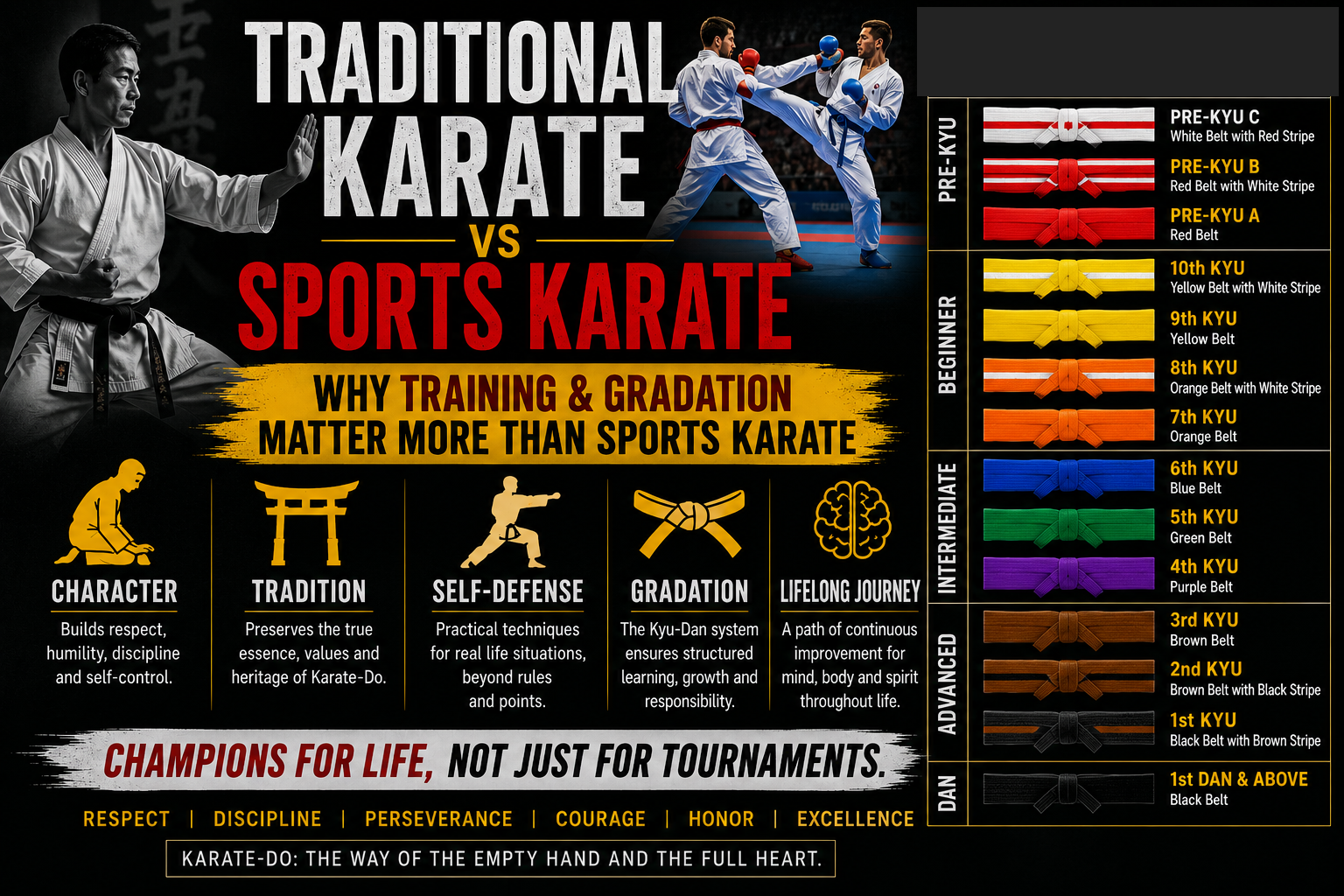
A Separate Track for Traditional Karate
Not all karate practitioners aspire to Olympic competition.
Traditional systems such as SANKUKAI and other Budo-based organizations focus on:
- Character development
- Technical mastery
- Dan grading
- International seminars
- Cultural exchange
These organizations should continue conducting:
- Seminars
- Grading examinations
- Traditional championships
- International exchanges
Such activities contribute significantly to karate’s growth.
The Role of Government
The Ministry of Youth Affairs and Sports, State Sports Councils, and District Sports Authorities should consider establishing:
Karate Development Boards
Responsible for:
- Event coordination
- Athlete registration
- Competition standards
- Safety protocols
Open Participation Policies
Athletes should not be excluded solely because of affiliation.
Unified Ranking Systems
Performance-based rankings can reduce dependency on organizational politics.
Recommendations
For the IOA
- Publish a clear roadmap for karate governance.
- Protect athlete opportunities during transition periods.
- Create temporary competition structures.
For State Governments
- Organize state-supported karate championships.
- Encourage district-level events.
- Recognize athlete achievements independently.
For Karate Organizations
- Prioritize athlete welfare over organizational interests.
- Collaborate where possible.
- Maintain open competition opportunities.
For Coaches and Dojos
- Continue athlete development.
- Focus on long-term skill building.
- Avoid unnecessary involvement in political disputes.
Author’s Reflection
“A champion is not created in boardrooms. A champion is created in dojos, schools, playgrounds, and training halls. Governance should exist to support that journey, never to obstruct it.”







Leave a Reply