

Informational Blog
Karate is one of the most respected martial arts in the world, known for its powerful techniques, disciplined training methods, and strong philosophical foundation. Though many people think of Karate as a single system, it actually consists of several styles, each developed by different masters with unique technical approaches and training philosophies.
The roots of Karate trace back to Okinawa, where indigenous fighting methods called Te blended with Chinese martial arts. During the late nineteenth and early twentieth centuries, Okinawan masters refined these teachings and introduced them to mainland Japan. Over time, these teachings evolved into distinct systems known as Ryu, meaning “school” or “tradition.” Each school developed its own training methods, philosophy, and technical approach while maintaining the core spirit of Karate.
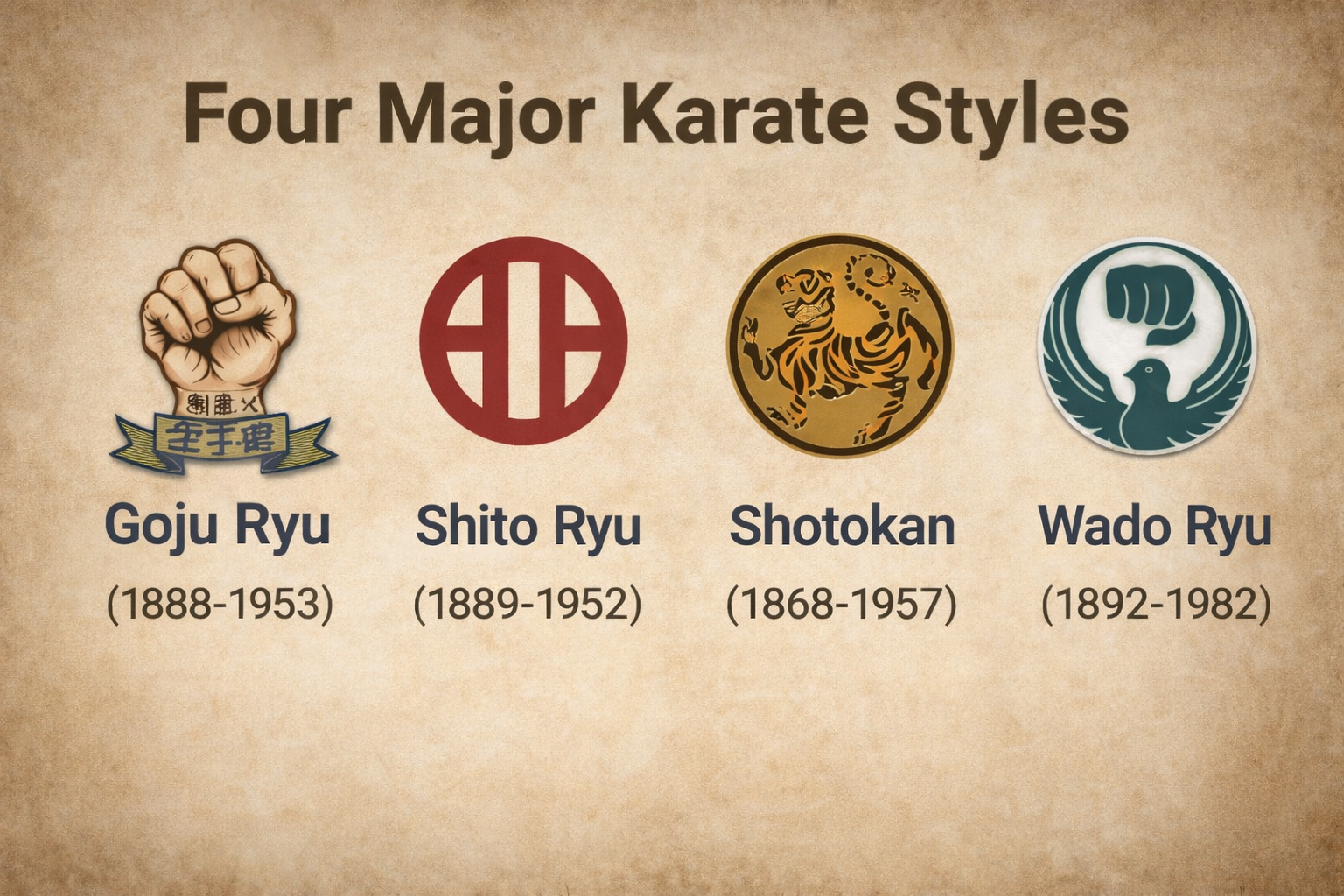
Among the many styles that developed, five have become globally recognized as the major Karate styles: Shotokan, Goju-Ryu, Shito-Ryu, Wado-Ryu, and Kyokushin. Each of these styles offers a different approach to movement, strategy, and training, reflecting the philosophy and experience of their founders.
Shotokan Karate is one of the most widely practiced Karate styles in the world. It was founded by Gichin Funakoshi, who introduced Karate from Okinawa to mainland Japan in 1922. Funakoshi is often referred to as the father of modern Karate because of his efforts to systematize Karate training and promote it internationally. Shotokan training emphasizes strong fundamentals and a clear structure built on three pillars: Kihon (basics), Kata (forms), and Kumite (sparring). The techniques of Shotokan are characterized by long, powerful, and linear movements. Practitioners develop strong stances such as Zenkutsu-dachi (front stance), Kokutsu-dachi (back stance), and Kiba-dachi (horse stance). These stances allow the practitioner to generate power through hip rotation and proper body alignment, enabling punches and kicks to deliver maximum impact. Shotokan also preserves many traditional kata, including the Heian series, Tekki series, Bassai Dai, Kanku Dai, and Jion. These kata contain important combat principles that practitioners must study and interpret. Funakoshi believed that Karate was not merely a system of fighting but a way of developing character and discipline. His famous teaching states that the ultimate aim of Karate lies not in victory or defeat, but in the perfection of character. Because of its structured training system, Shotokan has had a major influence on modern sport Karate and organizations such as the World Karate Federation.
Goju-Ryu Karate was founded in Okinawa by Chojun Miyagi. The name Goju-Ryu literally means “Hard-Soft Style,” reflecting the philosophy that effective martial arts combine both powerful striking techniques and softer circular movements that redirect an opponent’s force. Goju-Ryu places strong emphasis on close-range combat and body conditioning. Techniques often include circular blocks, elbow strikes, knee strikes, joint locks, and short powerful punches. Instead of relying primarily on long-distance attacks, Goju practitioners specialize in infighting and controlling an opponent at close range. One of the most distinctive aspects of Goju-Ryu is its breathing system, which is especially developed through the practice of Sanchin Kata. This kata trains internal power, breathing control, body tension, and mental focus. Traditional Goju-Ryu training also includes supplementary exercises known as Hojo Undo. These exercises use traditional training tools such as Chi-ishi (stone lever weights), Nigiri-game (gripping jars), and Makiwara (striking boards). These tools strengthen the body and develop the conditioning required for powerful strikes and effective self-defense.
Shito-Ryu Karate was founded by Kenwa Mabuni, one of the most knowledgeable Karate masters of his time. Mabuni studied under two legendary Okinawan teachers, Anko Itosu and Kanryo Higaonna. The name Shito-Ryu combines characters from the names of these two masters as a tribute to their influence. One of the defining features of Shito-Ryu is its extensive kata curriculum. The style preserves more traditional kata than most other Karate systems, often including more than fifty different kata. Famous kata practiced in Shito-Ryu include Nipaipo, Seienchin, Bassai, Suparinpei, and Chatanyara Kusanku. Because of this rich kata heritage, Shito-Ryu practitioners often excel in kata competitions and demonstrations. Technically, Shito-Ryu blends two major Okinawan traditions: Shuri-te and Naha-te. The Shuri-te influence emphasizes speed, light movement, and long-distance techniques, while the Naha-te influence emphasizes strong breathing methods, close-range fighting, and powerful body conditioning. This combination makes Shito-Ryu a balanced and versatile Karate system.
Wado-Ryu Karate was founded by Hironori Otsuka. The name Wado-Ryu means “Way of Harmony.” Unlike many Karate styles that rely heavily on powerful blocking techniques, Wado-Ryu emphasizes avoiding attacks through body movement and positioning. Before studying Karate, Otsuka was already a master of Japanese Jujutsu, and this background strongly influenced the development of Wado-Ryu techniques. Important principles in Wado-Ryu include Tai Sabaki (body shifting), Nagashi (deflecting attacks), and Kuzushi (breaking the opponent’s balance). Instead of meeting force with force, practitioners use movement and timing to neutralize an opponent’s attack. Wado-Ryu techniques therefore emphasize light stances, fast footwork, efficient movement, and minimal use of force. Practitioners aim to blend with the opponent’s movement and redirect energy rather than stopping it directly.
Kyokushin Karate was founded by Masutatsu Oyama and is known for its extremely demanding training and full-contact fighting style. The name Kyokushin means “Ultimate Truth.” This style emphasizes physical endurance, mental toughness, and realistic fighting ability. Kyokushin training includes intense conditioning exercises designed to strengthen the body and increase resistance to strikes. Students practice heavy bag training, body conditioning drills, and rigorous sparring sessions. Kyokushin competitions are famous for their knockdown fighting format, where fighters deliver powerful body punches, low kicks, and knee strikes with full contact. Another distinctive feature of Kyokushin training is Tameshiwari, or breaking techniques, in which practitioners break boards, bricks, or stones to demonstrate power, focus, and precision.
Although these styles differ in their techniques and training methods, they share a common heritage and purpose. Shotokan focuses on strong basics and long-range techniques. Goju-Ryu emphasizes the balance of hard and soft movements in close-range combat. Shito-Ryu preserves a vast traditional kata system and offers a balanced technical approach. Wado-Ryu focuses on evasion and harmonious body movement, while Kyokushin emphasizes full-contact fighting and physical toughness.
The development of these styles reflects the evolution of Karate from its Okinawan origins into a global martial art practiced by millions around the world. Despite their differences, all Karate styles aim to develop not only physical skill but also mental discipline and strong character. Karate is more than a system of combat; it is a lifelong path of self-improvement that teaches respect, perseverance, humility, and self-control.









Leave a Reply